

 Ambi-8.pdf
Product Overview
The Ambi-8 is a DIY eight-capsule Ambisonic microphone kit designed for spatial recording, immersive audio, soundscape capture, experimental recording, and education.
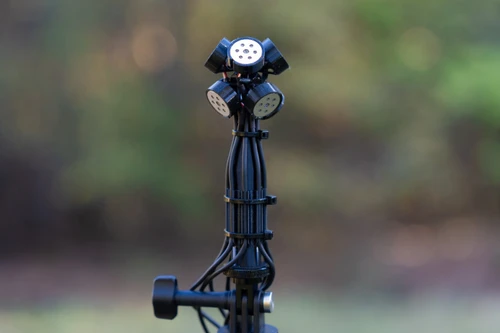
Rather than using the four capsules found in a conventional tetrahedral Ambisonic microphone, Ambi-8 uses eight JLI microphone capsules arranged around the microphone in two alternating elevation groups. Capsules are positioned at 45° intervals around the array, with alternating capsules at +45° and -45° elevation. This geometry is designed to provide strong horizontal spatial information while improving the microphone’s ability to capture height information.
Each capsule is recorded independently through its own XLR connection using a simple phantom-powered interface. The result is an eight-channel raw recording that can be encoded for use in an Ambisonic workflow.
Ambi-8 is a DIY kit and requires assembly, soldering, and a recorder or audio interface with eight microphone inputs capable of supplying 48 V phantom power.
Eight Capsules for Spatial Recording
Ambisonic recording captures a sound field rather than committing the recording to a conventional left/right stereo image at the microphone.
Ambi-8 expands on the familiar four-capsule Ambisonic array by using eight individual microphone capsules. The capsules are distributed around the full 360° horizontal field while alternating between upward and downward elevation angles.
The top group contains capsules at 0°, 90°, 180°, and 270° azimuth at +45° elevation. The lower group fills the positions between them at 45°, 135°, 225°, and 315° azimuth at -45° elevation.
This arrangement is intended to capture both the direction of sounds around the microphone and useful information about sounds arriving from above and below.
Design & Signal Path
The Ambi-8 structure consists of a 3D-printed base, an eight-position geometry section, and individual capsule holders. Integrated cable guides organize the eight microphone leads as they leave the array.
Each channel uses one JLI-160A11UC680 microphone capsule connected through a Simple P48 circuit. The circuit uses a resistor and capacitor to interface the electret capsule with a microphone preamplifier supplying 48 V phantom power.
Every capsule has its own 10-foot Mogami W2697 cable terminated with a genuine Neutrik NC3MXX-B 3-pin male XLR connector. Color-coded XLR boots identify channels 1 through 8 and make it easier to maintain the correct channel order when connecting the microphone to a recorder.
What’s Included
- 1 × 3D-printed Ambi-8 microphone base with installed 1/4-20 brass threaded insert
- 1 × 3D-printed eight-capsule geometry piece
- 8 × 3D-printed capsule holders
- 8 × JLI-160A11UC680 microphone capsules
- 80 ft total Mogami W2697 microphone cable, supplied as eight 10 ft lengths
- 8 × 100 k Ω resistors
- 8 × 3.3 µF / 63 V capacitors
- 8 × Neutrik NC3MXX-B 3-pin male XLR connectors
- 8 × color-coded XLR boots
- Heat-shrink tubing for the microphone cable assemblies
Basic soldering and wire-preparation tools are required for assembly. The builder must also supply suitable adhesive, cable ties, and a heat source for the included heat-shrink tubing.
Key Features
- Eight-capsule Ambisonic array
Uses twice as many capsules as a conventional four-capsule tetrahedral microphone. - Alternating +45° / -45° capsule elevation
Designed to capture useful height information while retaining strong horizontal spatial information. - Eight discrete recording channels
Every microphone capsule is recorded independently for later Ambisonic encoding. - JLI-160A11UC680 microphone capsules
Eight JLI capsules form the acoustic array. - 48 V phantom-powered operation
Each capsule interfaces with a standard microphone preamplifier through a Simple P48 circuit. - Neutrik NC3MXX-B XLR connections
Eight color-coded 3-pin male XLR connectors simplify channel identification and recorder setup. - 10-foot Mogami W2697 cable on every channel
Provides flexibility when positioning the microphone away from the recorder. - Integrated cable management
The printed microphone structure includes guides for organizing all eight microphone cables. - 1/4-20 tripod mounting provision
A brass threaded insert is pre-installed in the printed microphone base for mounting on a suitable tripod or support. - Documented encoding workflow
The supplied build and use guide covers recording setup and the beginning of an Ambisonic encoding workflow using REAPER and SPARTA Array2SH.
Recording & Ambisonic Workflow
Ambi-8 produces eight discrete microphone channels. For a complete Ambisonic recording, all eight channels should be recorded simultaneously and kept in the correct channel order.
The recommended basic recording workflow is:
- Connect all eight Ambi-8 XLR outputs to the recorder in channel order.
- Enable 48 V phantom power on all eight microphone inputs.
- Use the same input gain setting for all eight channels.
- Record the microphone as a single eight-channel WAV file where supported.
- Transfer the multichannel recording to a DAW for Ambisonic encoding.
The Ambi-8 build guide demonstrates this workflow using REAPER and the open Ambisonic processing tools in SPARTA. A supplied JSON preset contains the Ambi-8 array geometry for the SPARTA Array2SH encoder.
Download the Ambi-8 SPARTA Array2SH preset
Once encoded to Ambisonic B-format, the recording can be used with compatible decoding and processing tools for applications including binaural headphone playback, immersive media, beamforming, and multichannel loudspeaker reproduction.
Applications
- Environmental and soundscape recording
- Nature and wildlife recording
- Immersive and spatial audio production
- Ambisonic field recording
- Binaural and headphone-oriented production
- Multichannel speaker reproduction
- Spatial music and experimental recording
- Room and architectural acoustics
- Sound effects gathering
- Education and Ambisonics experimentation
Who This Kit Is For
Ambi-8 is intended for soundscape recordists, spatial-audio creators, educators, experimenters, and DIY microphone builders who want to explore recording sound in three dimensions.
The assembly is straightforward for builders comfortable with soldering microphone cables and electronic components, but Ambi-8 is not a plug-and-play finished microphone. Building the kit requires assembling eight individual microphone channels and installing the capsules into the supplied array structure.
The completed microphone also requires recording equipment capable of handling eight simultaneous phantom-powered microphone inputs.
Technical Description
Ambi-8 uses eight JLI-160A11UC680 microphone capsules arranged at 45° azimuth intervals around the microphone.
Capsules 1, 3, 5, and 7 form the upper group at +45° elevation. Capsules 2, 4, 6, and 8 form the lower group at -45° elevation and are offset horizontally by 45° from the upper capsules.
Each capsule is connected through its own Simple P48 circuit and XLR connector. The eight outputs remain discrete during recording so that the spatial information captured by the array can be processed later by an appropriate Ambisonic encoder.
Specifications
| Product Type | DIY Ambisonic microphone kit |
| Microphone Capsules | 8 × JLI-160A11UC680 |
| Number of Recording Channels | 8 |
| Horizontal Capsule Spacing | 45° azimuth increments |
| Upper Capsule Elevation | +45° |
| Lower Capsule Elevation | -45° |
| Powering | 48 V phantom power required on all eight channels |
| Output Connections | 8 × Neutrik NC3MXX-B 3-pin male XLR connectors |
| Cable | Mogami W2697 |
| Cable Length | 10 ft per channel / 80 ft total |
| Channel Identification | Color-coded XLR boots |
| Mounting | 1/4-20 tripod mounting provision |
| Recommended Recording Format | Single eight-channel WAV file where supported |
| Documented Encoding Software | REAPER with SPARTA Array2SH |
| Assembly Required | Yes |
Assembly & Software
The illustrated Ambi-8 build guide covers construction of the Simple P48 circuits, cable preparation, capsule wiring, installation of the eight capsule holders, channel identification, cable bundling, recorder setup, and the beginning of the Ambisonic encoding workflow.
The software workflow documented in the guide uses:
Additional information about the Ambi-8 and Ambi-12 project is available at Instructables.
Frequently Asked Questions
Is Ambi-8 a finished microphone?
No. Ambi-8 is a DIY microphone kit and requires soldering, cable preparation, and mechanical assembly.
How many recorder inputs are required?
Eight microphone inputs are required to record the complete array. Each channel must be capable of supplying 48 V phantom power.
Why does Ambi-8 use eight capsules?
The eight-capsule geometry distributes microphone elements around the full horizontal field while alternating their elevation between +45° and -45°. The array is designed to capture useful information about both horizontal direction and height.
Does the microphone record normal stereo?
Ambi-8 records eight discrete microphone channels rather than a finished two-channel stereo signal. The channels are intended to be encoded and decoded using compatible Ambisonic software.
What software is required?
Ambisonic processing can be performed with several compatible software packages. The JLI build guide documents a workflow using REAPER and SPARTA Array2SH and provides a preset containing the Ambi-8 array geometry.
Can I use a four-channel recorder?
Not for a complete Ambi-8 recording. The full array requires all eight microphone channels to be recorded simultaneously.
Do all eight recorder channels need the same gain?
Yes. The build guide recommends linking the input trims or otherwise using the same gain setting across all eight channels so that the spatial relationship between the capsules is preserved.

